

Object Record
Images
Metadata
Title |
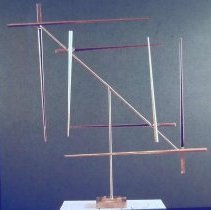
Unstable Rhombus and Square |
Artist |
Rickey, George |
Medium |
stainless steel |
Date |
1981 |
Description |
George Rickey, born in South Bend, Indiana in 1907, one of the world's foremost kinetic sculptors, followed the pioneering path of Alexander Calder. Rickey's father was a mechanical engineer and his grandfather was a clockmaker. Rickey developed a knack for mechanical things. He recieved his formal educations from Balliol College, Oxford, and began his artistic training at the Ruskin School of Drawing. In 1930 he returned to the United States and began a period of 20 years that were dedicated to painting. His mechanical aptitude surfaced while he was serving in the U.S. Army Air Corps. As in all of his sculptures, in Rickey's sculpture, "Unstable Rhombus and Square" movement is initiated through wind or indoor air currents. The subsequent motion is governed by the weight and precise position of each component of the sculpture. Rickey's sculptures demonstrate the laws of physics dealing with force, friction, gravity, inertia and pendulum movement. Eight stainless steel rods are oriented around a central shaft. As air currents cause each rod to move, they create square and rhomboid shapes. Rickey's kinetic sculpture, composed with movement, provides a skillfully choreographed definition of shape and space. |
Collection |
Permanent Collection |
Dimensions |
H-36 W-36 inches |
Credit line |
1986 Gift of the Family of Albert Thalheimer |